Male vs Female Rhodesian Ridgeback: Temperament and Fit
Puppy matching guide
Male vs Female Rhodesian Ridgeback: Temperament and Fit
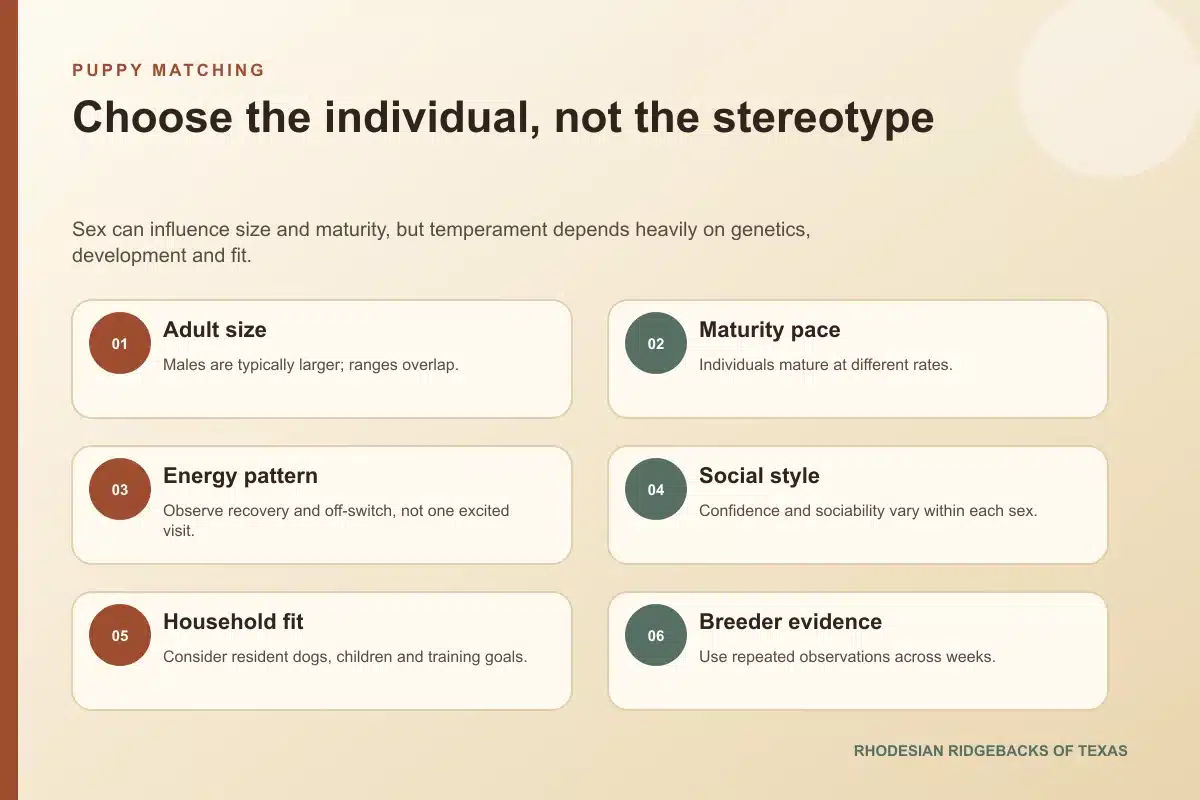
Sex can influence size and maturity, but the best match comes from the individual puppy’s behavior, development and fit with your household.
A clearer decision
What this guide helps you evaluate
“Should I choose a male or female Rhodesian Ridgeback?” is one of the most common questions prospective owners ask. It is understandable: adult males are usually larger, intact males and females have different management needs, and owners often hear confident generalizations about personality.
The expert answer is more useful than a stereotype. The Rhodesian Ridgeback standard describes an even, dignified dog that is devoted and affectionate with its owner and reserved with strangers. Those breed traits occur in both sexes. Within a litter, individual differences in confidence, persistence, sociability, arousal and recovery can be greater than the average difference between males and females.
Typical physical differences
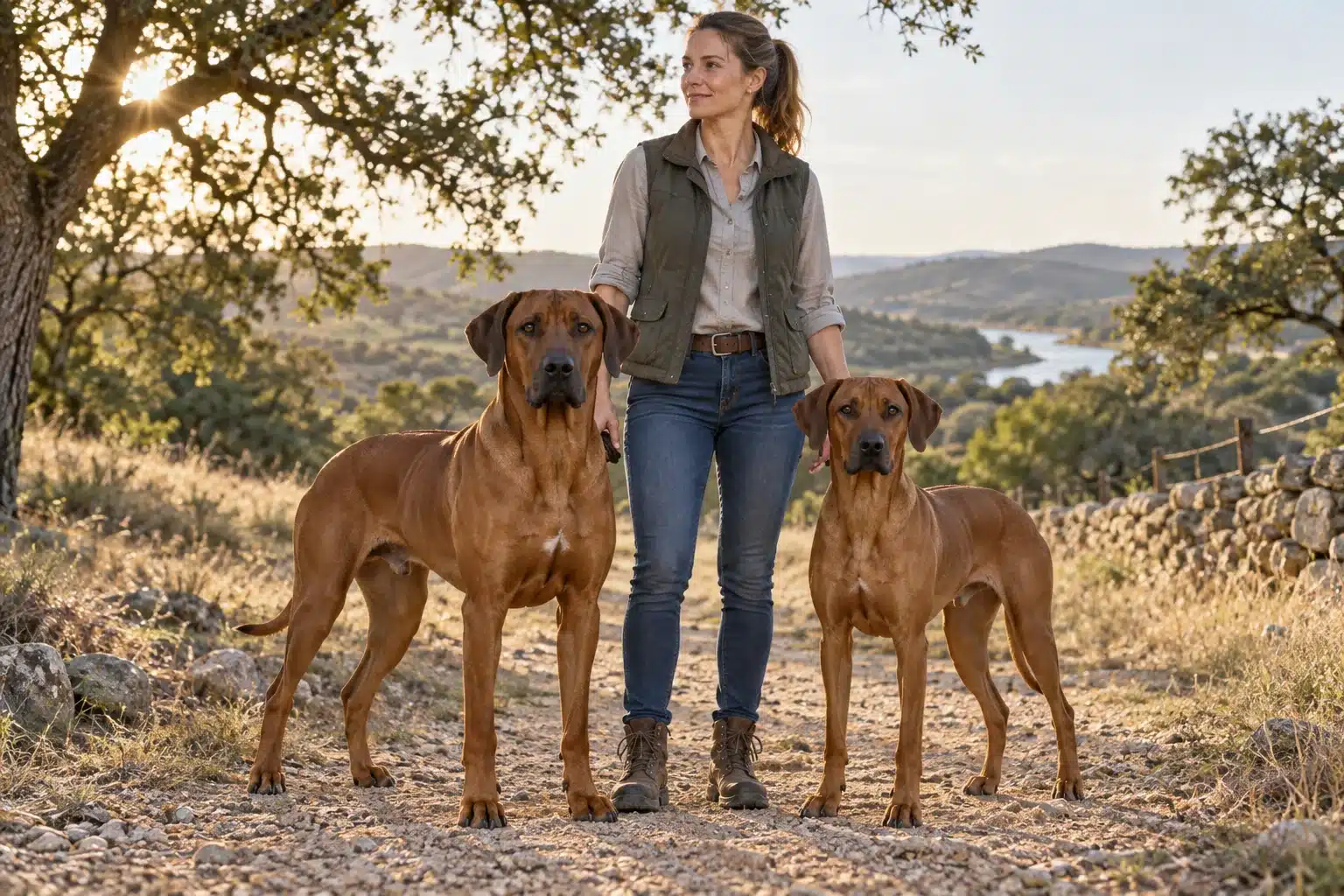
Adult males are generally taller and heavier than adult females. The AKC standard gives males a desired height of 25–27 inches and about 85 pounds, and females 24–26 inches and about 70 pounds. Individual dogs can fall above or below those averages.
| Decision factor | Why it matters |
|---|---|
| Adult size and strength | Handling, vehicle space, travel and household members |
| Intact-dog management | Heat cycles, marking, roaming risk and separation from intact dogs |
| Resident dogs | Individual social style and compatibility may affect the match |
| Training experience | A large, independent hound requires consistent reward-based training regardless of sex |
Temperament traits to evaluate instead of sex
A single excited visit does not reveal a puppy’s complete temperament. Experienced breeders observe puppies repeatedly across normal routines and novel situations. Useful traits include:
- Recovery: how quickly the puppy returns to normal after a mild surprise.
- Human engagement: willingness to check in, interact and accept handling.
- Persistence: whether the puppy keeps working at a solvable problem or disengages.
- Arousal: how quickly excitement rises and whether the puppy can settle.
- Environmental confidence: curiosity on new surfaces and around unfamiliar objects.
- Social style: approach, play, boundaries and response to other dogs.
Common stereotypes—and the better question
“Females are easier to train.”
Trainability varies among individuals. Motivation, handler skill, reinforcement history, maturity and the environment all matter. Ridgebacks of either sex can be independent thinkers. Ask which puppy shows an appropriate combination of engagement, resilience and ability to settle for your goals.
“Males are more affectionate.”
Affection is not sex-exclusive. Some dogs seek close physical contact; others prefer to stay nearby without constant touching. Ask how each puppy solicits interaction and responds when a person ends it.
“Females are less dominant.”
“Dominance” is often used too broadly. Resource guarding, dog-dog conflict, fear, overarousal and poor impulse control are different behaviors with different causes. The American Veterinary Society of Animal Behavior recommends reward-based training and cautions against dominance-based methods.
“A male is automatically better with children.”
No sex is automatically child-safe. Parent temperament, puppy behavior, socialization, training and active adult supervision determine far more. Ridgebacks are powerful dogs; children and dogs should not be left to manage interactions themselves.
How spay/neuter timing affects the decision
Discuss timing with a veterinarian who understands large-breed development and your dog’s medical and behavioral context. Surgery can prevent reproduction and change certain hormone-linked behaviors, but it does not rewrite the dog’s underlying temperament or replace training. Do not choose a sex based on the assumption that surgery will solve fear, reactivity or manners.
Matching a Ridgeback to your household
- Describe your real weekday—not your ideal weekend.
- Share children’s ages, resident animals, fencing and training experience.
- Explain whether you want a hiking companion, sport prospect, show prospect or family companion.
- State your preferences, but allow temperament observations to guide the match.
- Ask what the breeder has observed across feeding, handling, separation, play and new experiences.
Ready to take the next step?
Review the current litter and tell us about your household, experience and goals.
Frequently asked questions
Are male Ridgebacks always larger?
Males are larger on average, but individual ranges overlap. Review the parents and the puppy’s growth pattern rather than relying on sex alone.
Which sex is better with another dog?
Compatibility depends on both dogs’ age, behavior, reproductive status, social history and management. Opposite-sex pairings are sometimes easier, but there is no guarantee.
Which sex is better for a first-time owner?
Neither sex makes the breed automatically easy. The AKC describes Ridgebacks as independent, strong-willed and best suited to owners prepared for patient, consistent training and secure off-leash management.
Continue with our puppy socialization timeline and matching-process guide.
Thoughtful placement starts with a conversation
Tell us what kind of Ridgeback home you can provide.
Share your household, schedule, experience and goals so we can discuss timing and fit honestly.
Availability, dates and individual puppy details can change. Confirm current information directly before making plans.