Rhodesian Ridgeback Health Testing Checklist: What Responsible Breeders Screen For
A responsible Rhodesian Ridgeback breeder does more than say that the parents are “healthy” or “vet checked.” Breed-specific health testing uses orthopedic evaluations, specialist examinations, laboratory panels, and DNA tests to help breeders make informed decisions and help puppy buyers verify those decisions.
The short version: ask for the registered names of both parents and independently confirm their results in the Orthopedic Foundation for Animals (OFA) database. For Rhodesian Ridgebacks, the most important screening areas include hips, elbows, thyroid, heart, and eyes. The Rhodesian Ridgeback Club of the United States (RRCUS) also encourages breed-relevant DNA testing, including degenerative myelopathy, juvenile myoclonic epilepsy, and early-onset adult deafness.
This guide is educational and is not a diagnosis or a substitute for advice from your veterinarian. Recommendations can change, so check current RRCUS Health & Genetics resources and OFA guidance.
Quick Rhodesian Ridgeback health testing checklist
Before placing a deposit, ask to see verifiable results for both the sire and dam:
- Hips: OFA hip evaluation at 24 months or older, or an accepted PennHIP evaluation
- Elbows: OFA elbow evaluation at 24 months or older
- Thyroid: Complete autoimmune thyroid panel through an OFA-approved laboratory
- Heart: Cardiac examination with results recorded through OFA
- Eyes: Current CAER eye examination by a board-certified veterinary ophthalmologist
- DNA tests: Degenerative myelopathy (DM), juvenile myoclonic epilepsy (JME), and early-onset adult deafness (EOAD)
- Hearing: Ask whether BAER testing has been completed
- Public verification: Review each actual result in the OFA database—not only whether a test appears
Passing one test does not replace the others. A broad consumer DNA panel cannot evaluate hip or elbow structure, cardiac health, thyroid function, or the eyes.
1. Hip evaluation
Hip dysplasia is abnormal development of the hip joint that can contribute to pain, arthritis, and reduced mobility. A dog can move normally and still have abnormal hip structure, so appearance and activity are not substitutes for imaging.
For an OFA final hip evaluation, radiographs are taken by a veterinarian and submitted for review when the dog is at least 24 months old. Preliminary OFA evaluations may be performed earlier, but they are not the same as a final adult clearance. PennHIP is another accepted method that measures joint laxity and can be performed younger.
What to verify: identity, age at testing, evaluation method, date, and result. If PennHIP was used, ask for the complete report and how its score was interpreted for the breed.
2. Elbow evaluation
Elbow dysplasia describes developmental abnormalities that can lead to arthritis and lameness. A normal gait is not proof of normal elbow structure.
OFA elbow screening uses radiographs, with final certification at 24 months or older. RRCUS calls for hip and elbow screening of breeding dogs and disclosure of results to puppy buyers.
What to verify: a final OFA result for each parent when bred at or after 24 months. If a parent was younger, review preliminary results and ask about the plan for final testing.
3. Complete thyroid panel
Autoimmune thyroiditis can progress before obvious signs appear. A breed-appropriate thyroid evaluation is more useful than a single basic thyroid value.
RRCUS recommends a complete panel including free T4 by equilibrium dialysis, canine thyroid-stimulating hormone (cTSH), and thyroglobulin autoantibodies (TgAA). Its screening guidance recommends annual testing from ages one through six, followed by a final evaluation at age eight.
What to verify: date, age, laboratory, and every component of the panel. An old normal result does not show whether repeat testing stayed current.
4. Cardiac examination
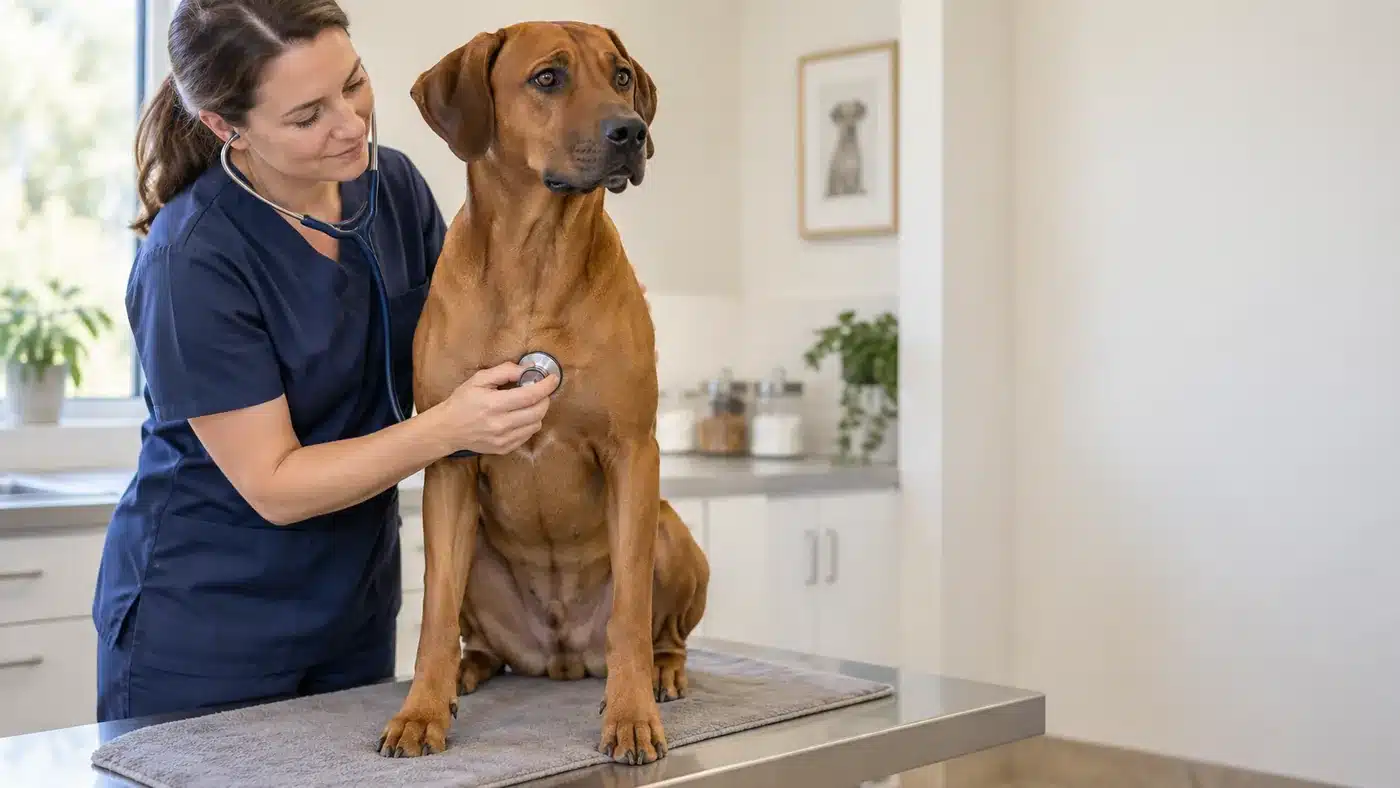
Cardiac screening checks for evidence of congenital or adult-onset heart disease. OFA maintains basic and advanced cardiac databases. A board-certified veterinary cardiologist has the most specialized training, and an advanced evaluation includes an echocardiogram.
RRCUS includes cardiac certification among its strongly recommended screenings. Verify who performed the exam, whether it was basic or advanced, the dog’s age, date, and result.
5. Annual eye examination
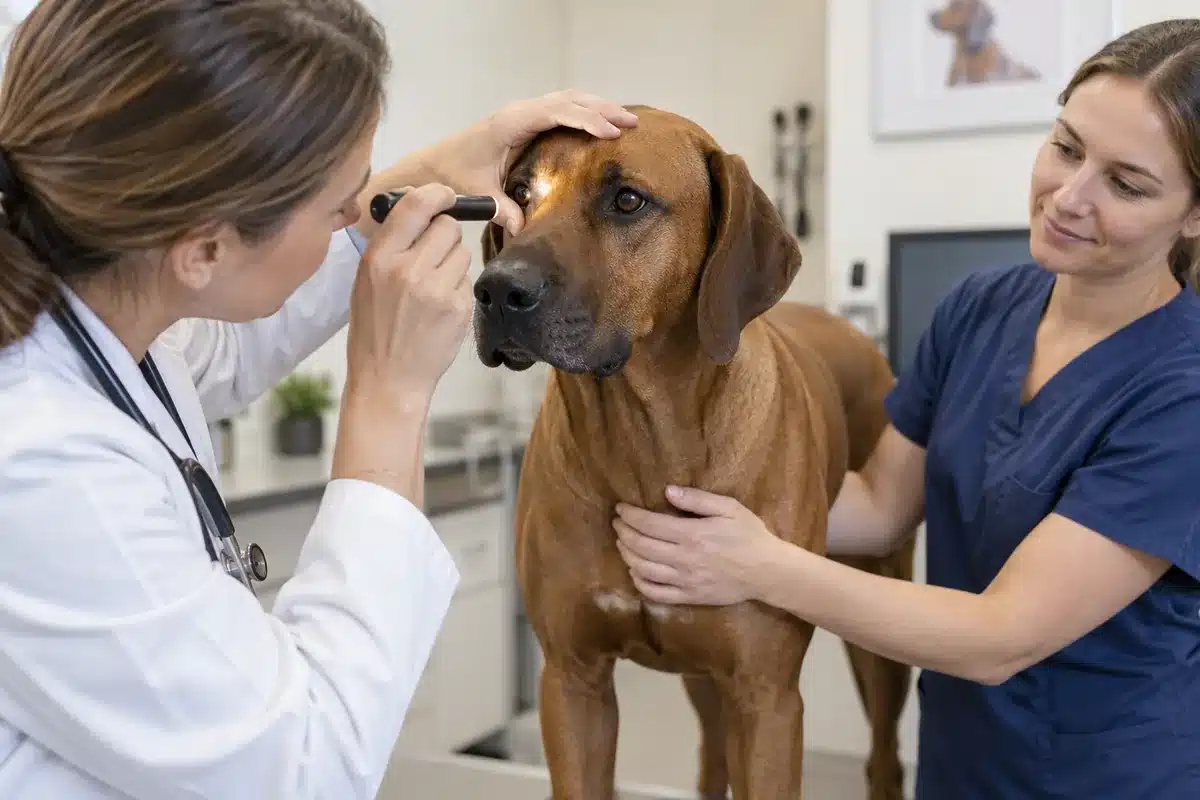
Inherited eye conditions may not be obvious without a dilated examination. A CAER examination is performed by a board-certified veterinary ophthalmologist and evaluates the eyes for inherited or suspected inherited abnormalities.
RRCUS recommends annual eye certification for breeding stock and advises annual eye examinations through age nine. Because findings can change, look at the date rather than treating a years-old certificate as permanently current.
6. Breed-relevant DNA testing
RRCUS encourages DNA testing for three autosomal recessive conditions relevant to Rhodesian Ridgebacks:
- Degenerative myelopathy (DM): a progressive neurologic disease associated with variants in the SOD1 gene
- Juvenile myoclonic epilepsy (JME): an inherited seizure disorder that can begin in young dogs
- Early-onset adult deafness (EOAD): an inherited form of hearing loss that may develop after puppyhood
DNA results may be clear, carrier, or at risk/affected for a variant. A carrier is not automatically an unhealthy dog. For an autosomal recessive condition, RRCUS notes that a carrier may be bred to a clear dog, while carrier-to-carrier matings should be avoided to prevent affected puppies. Responsible decisions consider both parents, the pedigree, and genetic diversity—not one result in isolation.
What to verify: the exact condition, laboratory, registered identity, and result for both parents. “DNA tested” is too vague.
7. BAER hearing testing
BAER stands for brainstem auditory evoked response. It objectively measures whether sound signals travel through the auditory pathway and can identify hearing loss that observation may miss.
RRCUS encourages BAER testing and notes that inherited deafness in the breed can appear later in the first year. Its guidance advises testing at one year rather than relying only on a puppy’s response to sound.
What about dermoid sinus?
Dermoid sinus is a congenital, tube-like skin defect associated with the breed. It is not cleared by the routine hip, elbow, eye, thyroid, cardiac, or DNA tests above. Newborn puppies should be carefully examined by someone experienced with the breed, and any concern should be evaluated by a veterinarian.
Ask how and when each puppy is checked, what happens if a sinus is suspected, and whether cases have occurred in related dogs. A breeder should disclose relevant health information rather than promise that risk is impossible.
How to verify a breeder’s claims
- Ask for registered names and registration numbers. Call names alone may not find the correct record.
- Search the OFA database yourself. Confirm dog, breed, sex, and identity.
- Open each result. A listed test is not necessarily a normal result.
- Check ages and dates. Final hip and elbow clearances differ from preliminaries; eyes and thyroid need repeats.
- Review both parents. One fully tested parent does not compensate for missing results on the other.
- Ask about the family. Responsible breeders consider siblings, previous offspring, longevity, temperament, and pedigree patterns.
- Get disclosure in writing. The puppy packet should include parents’ testing, puppy veterinary records, and health-guarantee terms.
Does a CHIC number mean every result was normal?
No. An OFA Canine Health Information Center (CHIC) number means the dog completed the breed-specific tests required at that time and the owner made results public. OFA explicitly states that a CHIC number does not mean every result was normal.
That transparency is valuable. Open records let buyers and breeders evaluate the complete information instead of seeing only selected passing results.
Questions to ask a Rhodesian Ridgeback breeder
- May I have the registered names and OFA links for both parents?
- Were hip and elbow results final or preliminary?
- When were the latest thyroid and eye tests completed?
- Who performed the cardiac exam, and was it basic or advanced?
- Which laboratory performed the DM, JME, and EOAD tests?
- If either parent is a carrier, what is the other parent’s verified status?
- Were the parents BAER tested at an appropriate age?
- How are puppies examined for dermoid sinus?
- What health information is in the contract and take-home packet?
- Will you remain available throughout the dog’s life?
A trustworthy breeder will welcome careful questions, explain results plainly, and encourage independent verification.
Health testing reduces risk—it does not guarantee an outcome
No screening program can guarantee that a dog will never develop a health problem. Some conditions are influenced by multiple genes, environment, age, or factors medicine does not yet fully understand. Testing still matters because it replaces guesswork with evidence, improves transparency, and supports informed choices.
For puppy buyers, the standard is simple: look for complete, current, verifiable results on both parents. For breeders, testing is part of a larger responsibility that includes temperament, structure, pedigree knowledge, puppy socialization, honest disclosure, and lifelong support.
Frequently asked questions
What health tests should a Rhodesian Ridgeback breeder do?
Responsible breeders should document hip and elbow evaluations and follow current RRCUS/OFA guidance for thyroid, cardiac, and eye screening. RRCUS also encourages DNA testing for DM, JME, and EOAD, plus BAER hearing testing.
At what age can a Rhodesian Ridgeback receive final OFA hip and elbow results?
OFA final hip and elbow certification is available at 24 months or older. Earlier radiographs may be submitted as preliminary evaluations. PennHIP follows a different protocol and can be performed earlier.
Is an Embark or another DNA panel enough?
No. DNA panels can be useful, but they do not replace radiographs, an ophthalmologist’s eye examination, a cardiac examination, or a complete thyroid panel.
Should I avoid a puppy if one parent is a carrier?
Not automatically. For an autosomal recessive condition, a carrier bred to a genetically clear mate should not produce affected puppies for that condition. Verify both reports and ask the breeder to explain the pairing.
Where can I verify health-test results?
Search the public OFA database using the dog’s registered name or number. Ask for original reports when a result is not recorded there.
Ready to evaluate a litter?
Use this checklist while reviewing our current Rhodesian Ridgeback puppies and planned litters. When you are ready to ask about parent health records, temperament, timing, and placement, complete our puppy request form.
Sources and further reading
- RRCUS Code of Ethics
- RRCUS Health Screenings
- RRCUS Health & Genetics
- OFA CHIC Program
- OFA Diseases and Screening Resources
- AKC Health Testing for Dogs
Reviewed against RRCUS and OFA resources on September 11, 2026. Recommendations can change; confirm current requirements with the parent club, OFA, and your veterinarian.