
How to Verify OFA Results for a Rhodesian Ridgeback
Buyer health guide
How to Verify OFA Results for a Rhodesian Ridgeback
A six-check process for confirming identity, testing dates, results and the complete health-screening pattern before you choose a breeder.
A clearer decision
What this guide helps you evaluate
Health testing is most useful when a puppy buyer can verify it independently. The Orthopedic Foundation for Animals (OFA) maintains a searchable database of canine health screening records. It lets you check the animal named by the breeder rather than relying on a cropped screenshot, a list of acronyms, or the statement that a line is “health tested.”
This guide explains exactly how to verify OFA results for a Rhodesian Ridgeback, how to read common certification numbers, and what to ask when a record is incomplete.
What you need before searching
Ask the breeder for the sire’s and dam’s exact registered names and registration numbers. Call names are often shared by many dogs and may not appear in the database. An AKC number is generally the most precise starting point for an AKC-registered dog.
- Registered name, including kennel prefix and punctuation
- AKC or other registry number
- Sex and approximate date of birth
- OFA/CHIC link, if the breeder already has one
Step-by-step: how to verify a dog in OFA
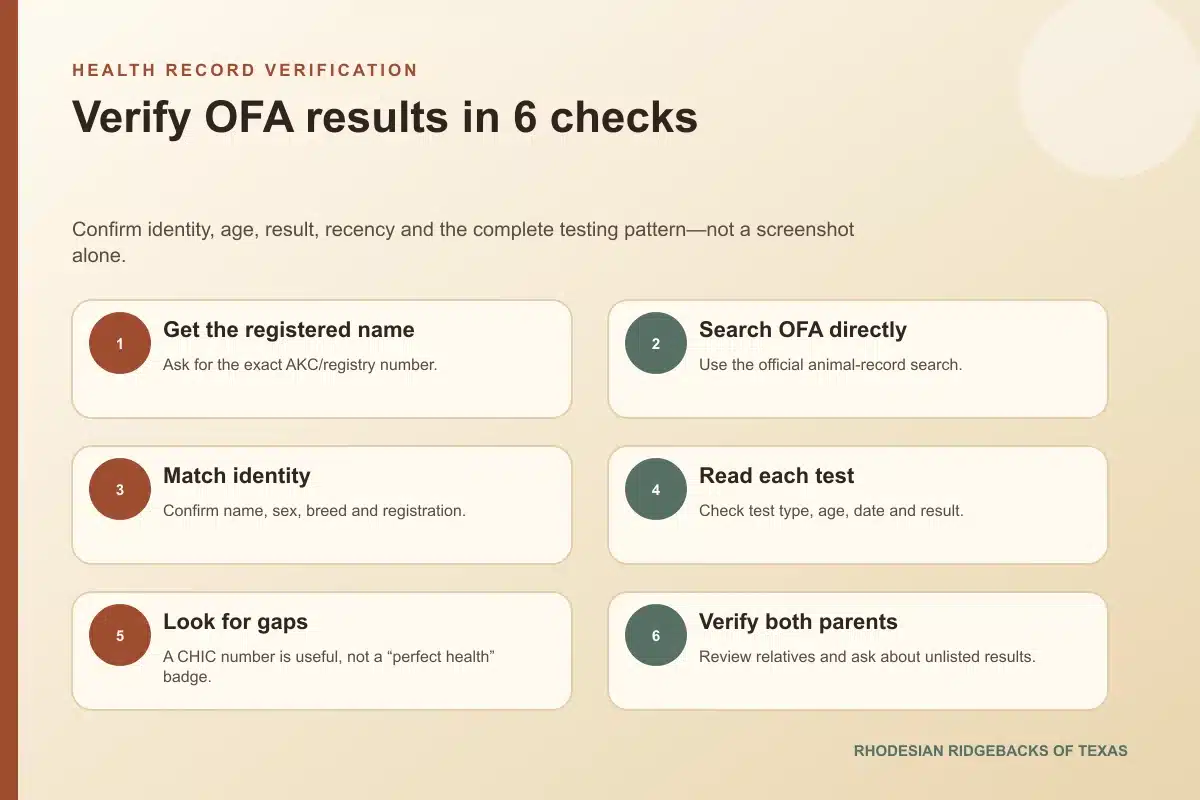
- Open the official OFA Advanced Search.
- Choose the search for a specific dog or litter.
- Enter the registration number first. If necessary, search by the registered name and filter the breed to Rhodesian Ridgeback.
- Open the individual animal record and compare the registered name, registration number, sex, breed and birth date with the breeder’s information.
- Review the entire health-test table—not only the first passing result.
- Repeat the search for the other parent and, when useful, close relatives.
How to read an OFA certification number
An OFA number is compact, but it carries useful information. A Rhodesian Ridgeback elbow result may look similar to RR-EL100F24-PI. The breed prefix identifies Rhodesian Ridgeback, the test code identifies elbows, the sex and age appear in the middle, and the suffix may indicate permanent identification. Cardiac certifications can also indicate whether the examination was performed by a general practitioner, specialist or board-certified cardiologist.
The Rhodesian Ridgeback Club of the United States OFA numbering guide explains the breed-specific codes. Do not judge a record by the number alone; open the animal’s record and read the result, examination date and age.
Preliminary versus final orthopedic results
Age matters. The RRCUS Code of Ethics distinguishes preliminary hip and elbow screening before 24 months from final screening at or after 24 months. A preliminary result can be useful during development, but it is not interchangeable with a final adult certification.
| Record | What to confirm | Common mistake |
|---|---|---|
| Hips/elbows | Dog’s age and final result | Treating a puppy preliminary as final |
| Eyes | Exam date and current status | Assuming one old exam is permanent |
| Thyroid | Panel type, date and result | Confusing a routine blood value with certification |
| Cardiac | Basic/advanced exam and examiner credential | Calling a normal puppy exam a cardiac clearance |
What a CHIC number does—and does not—mean
A CHIC number indicates that a dog completed the parent club’s required testing set and the results were made public. It does not mean every result was normal, and it is not a guarantee that the dog or its offspring will never develop disease. Open the underlying record and read each result.
Likewise, health screening reduces uncertainty; it cannot eliminate biological risk. Responsible breeding uses testing alongside pedigree analysis, family history, temperament, structure and honest disclosure.
What if a result is missing?
OFA notes that normal results submitted to its database are public. Its consumer guidance says that if a dog is absent from the database, it is reasonable to assume the dog was not screened through OFA or that abnormal results were not made public—unless the owner can document another recognized registry or laboratory. Ask a neutral question: “Can you send the registered number and the direct database link for both parents?”
A missing record is not solved by a photo of a healthy dog, a routine veterinarian wellness exam, DNA breed identification, or the phrase “vet checked.” Those describe different things.
Rhodesian Ridgeback buyer checklist
- Search sire and dam yourself.
- Confirm final hip and elbow results when the dog is over 24 months.
- Review thyroid, cardiac and eye records recommended by RRCUS/CHIC.
- Check dates and whether repeatable screenings are current.
- Ask about relevant family history and any abnormal findings.
- Keep copies of the direct record links with your puppy paperwork.
Ready to take the next step?
Review the current litter and tell us about your household, experience and goals.
Frequently asked questions
Can I search OFA without an OFA number?
Yes. Search by the dog’s registration number or registered name. A registration number usually produces the cleanest match.
Does “OFA Good” describe every health test?
No. “Good” is a hip-conformation grade. Other databases use results such as Normal, Clear or specific exam classifications.
Does an Embark panel replace OFA screening?
No. DNA testing and phenotype-based examinations answer different questions. Orthopedic radiographs, eye examinations, thyroid panels and cardiac evaluations cannot be replaced by a consumer DNA panel.
Educational information only; consult your veterinarian and the relevant registry for interpretation of a specific dog’s results.
Thoughtful placement starts with a conversation
Tell us what kind of Ridgeback home you can provide.
Share your household, schedule, experience and goals so we can discuss timing and fit honestly.
Availability, dates and individual puppy details can change. Confirm current information directly before making plans.